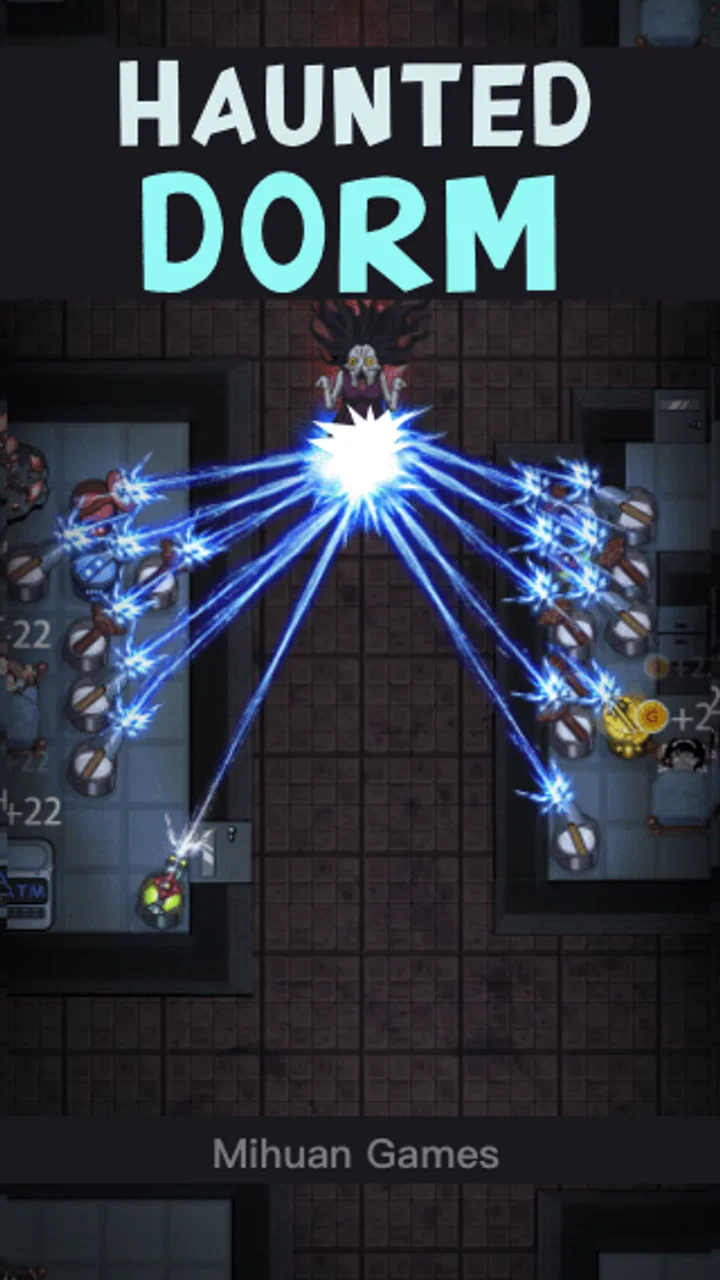
Haunted Dorm
- 3.4
- Rating
- 50.00M
- Installs
- Free
- Price

 Analysis by App-foxy
Haunted Dorm is a strategy game built around a very simple question: can I prepare a room, build the right defenses, and survive what comes looking for me? I found that its appeal comes less from a large story or a complicated control system and more from the pressure created after the first decision. I choose a room, start building, watch the threat approach, and then spend every reward trying to turn a fragile hiding place into something that can hold together.
That loop makes it easy to understand within a few minutes, but it is not completely mindless. The interesting choices are about timing, space, and accepting that I cannot improve everything at once. A turret may help immediately, while an income-producing building may be more valuable a little later. A defensive upgrade can save a run, but delaying it may leave me unable to afford the next important purchase. For players who enjoy short strategy sessions with a horror-flavored setting, this is an approachable option. For anyone expecting a deep campaign, extensive unit control, or a traditional tower-defense map, its narrow design may feel limiting.
Starting with one room and one urgent decision
The first action is deliberately clear: I need to establish a defensible position before the Dream Hunter becomes the only thing that matters. The game’s store summary describes the central idea as building turrets to drive away the hunter, and that is a good description of the immediate objective without explaining every decision around it. I am not simply placing defenses wherever I like. I am trying to create a setup that can earn enough resources and survive long enough to improve.
You May Also Like

 Pandora - Music & Podcasts
Pandora’s Music Is Easy to Start, but Harder to Recover
Pandora’s strength is its low-effort path from a seed to a station. Its weak spot is how much confidence it asks you to place in connection, setup, and quiet recovery.

 AccuWeather: Weather Radar
AccuWeather Review: A Quick, Clear Forecast for Everyday Decisions
For everyday plans, the best forecast is the one you can understand quickly. AccuWeather makes rain timing, radar, and local conditions easy to act on, with a few trade-offs.

 Hill Climb Racing
Why Hill Climb Racing Still Turns Crashes Into One More Run
A tiny car, a bumpy hill and one more upgrade: Hill Climb Racing keeps resurfacing because its simple chaos makes every near-miss feel personal.

 AliExpress - Shopping App
AliExpress Makes Global Shopping Feel Personal, but Shoppers Bear the Risk
AliExpress turns a global marketplace into a pocket-sized discovery engine. Its reach is useful, its shopping loop compelling, and its trade-offs easy to miss.

 Lords Mobile: Kingdom Wars
Lords Mobile Is a Kingdom-Building Routine, Not a Quick Match
A case-by-case verdict on the building, battles, device demands, and social commitments that make Lords Mobile rewarding for some players and exhausting for others.

 PDF Scanner app - TapScanner
TapScanner Makes Paperwork Easier to Capture, Check, and Share
TapScanner makes scanning with a phone feel less like a rescue operation and more like a dependable step in getting work done. Its capture tools are useful, though not flawless.
More From Our News Desk
View All News


That opening creates a useful kind of tension. At the start, my position feels temporary. I have a limited amount of time to make the room productive and protected, so every early purchase has a consequence. Spending too aggressively on offense can leave the room economically weak. Waiting too long to defend can make the first serious attack much harder to handle. The best opening is therefore not always the most powerful-looking one; it is the one that keeps future choices available.
I also like that the game makes the room itself feel important. In many familiar tower-defense games, the player studies a path and places defenses along it. Here, the feeling is more personal and enclosed. I am protecting a position rather than managing an entire battlefield. That smaller scale makes each improvement easier to notice, while also making mistakes feel more immediate.
The controls are suited to quick play. I can focus on selecting construction or upgrade choices rather than learning a large control scheme. That makes it comfortable for a short break, especially when I want something more interactive than a passive mobile game. The trade-off is that the simplicity leaves less room for elaborate planning. Players who want several classes, detailed formations, or a broad map to master may find the first action too restricted.
Why the opening choice matters more than it seems
The most useful early habit is to think in two stages instead of treating every purchase as an emergency response. First, I ask what will keep the room alive through the next attack. Then I ask what will make the following stretch easier. This sounds obvious, but the game’s pressure encourages short-term spending. The temptation is to buy whatever gives the most visible improvement immediately, even when a quieter investment would support the whole session.
I have found that the strongest openings come from leaving myself a little flexibility. A room that has one impressive defense but no room to adapt can be more vulnerable than a modest setup with a clear upgrade path. This is one of the game’s better strategic lessons: survival is not only about damage. It is also about keeping enough resources and space to answer the next problem.
That makes the first action useful for different kinds of players. Beginners can follow the obvious goal of building protection, while experienced strategy players can examine the hidden cost of each choice. The game does not need a complicated ruleset to create decisions; it uses scarcity and timing to make ordinary purchases meaningful.
Watching the feedback rhythm unfold
Once the defenses are active, the feedback rhythm becomes the real attraction. I see the room produce resources, the turrets respond to danger, and the threat test whether my preparation was good enough. Each successful exchange gives me information. If the defenses handle an attack comfortably, I can consider improving income or preparing for a stronger push. If the room barely survives, the result is a warning that the next purchase should probably be defensive.
This rhythm is satisfying because the game shows the effect of my decisions quickly. I do not have to wait through a long campaign to discover whether a basic plan works. The room answers me almost immediately. That direct feedback is also why a poor decision can be educational rather than simply annoying. I can usually identify whether I spent too early, upgraded the wrong priority, or failed to prepare for the pressure that was already visible.
The experience sits between active play and observation. I make the important choices, but I am not constantly aiming or moving a character through a level. That makes the game calmer than an action-heavy survival title while keeping more tension than an idle builder. I spend much of the session watching systems interact, then stepping in when the next upgrade or defense matters.
The best part of Haunted Dorm is the short distance between a decision and its consequence. A new turret is not just an item in a menu; it changes how the room handles the next threat. An economic improvement is not merely a number going up; it determines whether I can afford the response after that. This connection gives the otherwise compact game a satisfying sense of cause and effect.
Using feedback instead of guessing
One practical approach is to treat every attack as a test rather than a pass-or-fail judgment. If a defense is doing its job, I do not automatically replace it with something newer. I look at whether the room needs more coverage, more durability, or more income. The right answer changes depending on how the previous exchange went.
I also try not to upgrade simply because I have enough currency. Holding a small reserve can be more valuable than making a minor improvement, particularly when the next threat is close. This is a non-obvious strength of the design: the game rewards patience without becoming passive. I still need to act, but I am encouraged to act for a reason rather than spend whenever a button becomes available.
There is a similar lesson with defensive concentration. Putting too much confidence in one strong point may work while the pressure stays predictable, but it can leave the rest of the room exposed. A balanced setup is not always the most efficient one, yet it gives me more ways to recover when the session stops following my preferred plan. That makes the game more forgiving for newcomers while still giving experienced players room to experiment.
Rewards that keep the next decision alive
The reward stage is not just about feeling successful after an attack. The resources I earn become the fuel for the next decision, so the game turns survival into a continuing investment. I can use that reward to strengthen the immediate defense, improve the room’s ability to generate future resources, or prepare for a more demanding moment. Each option changes the shape of the next few minutes.
This is where the game’s strategy becomes more interesting than its simple presentation suggests. A reward can be spent in a way that makes the current position look stronger, or in a way that makes the entire session more stable. Those are not always the same thing. I may prefer the visible power of a turret upgrade, but an economic improvement can sometimes prevent a later shortage. The game is at its best when I have to choose between comfort now and flexibility later.
The reward loop also explains why another session feels inviting. I am not only trying to reach an endpoint; I am trying to understand which sequence of investments will produce a better result. After a failed run, I often remember one particular moment when I spent too much or reacted too late. That memory gives the next attempt a specific purpose instead of making it feel like a completely random restart.
Players should also understand the free-to-play context before committing. Haunted Dorm is free to play, but it includes in-app purchases ranging from $1.99 to $39.99 per item. That does not automatically decide whether the game is worthwhile, but it does matter if I prefer mobile games with no purchase prompts or if I am playing around a strict budget. I would approach the game as a free trial first and decide whether the core loop is enjoyable without spending.
Who gets the most from the reward system?
This structure suits players who enjoy gradual improvement and repeated attempts. It is particularly good for someone who likes asking, “What should I change next time?” rather than needing every session to deliver a new story chapter. The reward is partly the upgrade itself and partly the knowledge gained from seeing how that upgrade affects the room.
It is less suitable for a player who wants a clear collection system, a long narrative, or a large range of strategic roles. The game’s satisfaction comes from refining a compact loop, not from constantly unlocking a wide world. If I want a traditional tower-defense experience with multiple lanes, many enemy types, and extensive level variety, another game in the category may offer more breadth.
The age rating is Everyone 10+, which fits the spooky atmosphere and the pressure of defending against a threatening presence without making the game feel aimed only at adults. I would still consider the horror tone when choosing it for a younger player, especially if that player is sensitive to haunted settings. The presentation is approachable, but the central idea remains survival under pressure.
When a session resets and why I start again
The reset is an important part of the design. When a run ends, I lose the exact position I built, but I keep the lesson from it. That creates a clean break rather than a long recovery process. I can try a different opening, spend rewards in a new order, and test whether the change solves the problem that ended the previous attempt.
This reset works because the sessions are easy to understand. I am not returning to a huge map or replaying a lengthy story section just to reach the interesting part. The main loop gets me back to the decision quickly. That is a strong fit for mobile play: I can play during a short pause, stop when I need to, and return later without needing to remember a complicated plot.
The downside is that repetition can become noticeable. If I am not interested in optimizing the same basic pattern, a reset may feel like starting over rather than starting fresh. The compact design that makes the game accessible also limits its ability to surprise me over a long period. Its replay value depends heavily on whether I enjoy experimenting with timing and resource priorities.
For an everyday scenario, I can imagine opening it while waiting for a train or taking a short break between tasks. I do not need to prepare a long uninterrupted block of time or remember a complicated control layout. I can begin with the room, make a few meaningful choices, watch the defenses respond, and either finish the attempt or put the phone away. That convenience is one of the clearest reasons to choose it over a more demanding strategy game.
What to check before installing
Haunted Dorm is available as a free game from Mihuan Limited and belongs to the strategy category. It was released on February 28, 2022, and the current version is 1.8.3. It supports Android 7.0 and later, so it is accessible on a broad range of Android devices. The game has passed 50 million installs, with an average rating of 3.4 from around 316 thousand ratings and roughly 1.7 thousand written reviews. Those figures suggest a large audience but also a mixed reception, which matches my view that the focused loop will appeal strongly to some players and feel repetitive to others.
The practical question is not whether it is popular; it is whether this particular rhythm suits me. I should install it if I like compact defense planning, visible cause and effect, and restarting to improve a strategy. I should skip it if I need a rich story, a large battlefield, or a game that constantly introduces new systems. I would also avoid treating it as a relaxing idle title, because the pressure to spend carefully and prepare for the next attack gives the session a more active mental edge.
Another useful consideration is the difference between playing casually and trying to optimize. A casual player can enjoy the basic satisfaction of placing defenses and surviving for a while. A more serious player will get more from tracking which purchases created stability and which merely delayed a problem. The game supports both approaches, but it does not transform into a deep strategy simulator for the second group. Its ceiling is about making a small set of decisions better, not managing an enormous number of variables.
My verdict on the complete action-to-reset loop
After playing through the full cycle, I see Haunted Dorm as a focused strategy game with a clear identity. The action is choosing and building a defensive room. The feedback is watching those choices handle the approaching threat. The reward is gaining the means to improve either survival or future income. The reset is a quick invitation to test a better plan. None of these pieces is unusually complex on its own, but they connect cleanly enough to make another session feel justified.
I especially recommend it to players who enjoy learning through small mistakes. The game gives me enough control to feel responsible for the result, while keeping the rules approachable enough that I can understand what went wrong. Its enclosed setting also helps the decisions feel personal: I am not managing an abstract line of defenses, but trying to keep one vulnerable place from collapsing.
My reservations are equally clear. The narrow structure can become repetitive, and the game may not satisfy players looking for the variety of larger strategy alternatives. The mixed average rating is understandable because the same simplicity that makes the first session welcoming can make longer play feel predictable. The in-app purchase range is another reason to approach it thoughtfully rather than assuming every part of the experience will suit every player.
Still, as a free mobile game, it offers a convincing reason to return: I can see exactly how one changed decision might produce a better run. If you enjoy short strategy sessions where every upgrade feeds the next attempt, Haunted Dorm is worth trying; if you need broad content and constant novelty, choose a more expansive alternative instead. For me, its loop works best in small doses, when I want a tense but understandable challenge that begins with one room, ends with a reset, and makes the next attempt feel like a deliberate experiment.
FAQs for Haunted Dorm
01What is Haunted Dorm about?
Haunted Dorm is a unique blend of horror and strategy where players must survive a haunted dormitory. The game involves managing resources, setting traps, and ensuring your character stays safe from supernatural threats. Each decision impacts your survival, making it a thrilling and engaging experience for fans of horror games.
02Is Haunted Dorm suitable for younger audiences?
Haunted Dorm is designed with a horror theme, which may include scary imagery and intense scenarios. It is recommended for mature audiences or players who are comfortable with horror elements. Parental guidance is advised for younger players to ensure the content is appropriate for them.
03What are the key features of Haunted Dorm?
Haunted Dorm offers an immersive experience with its strategic gameplay and eerie atmosphere. Key features include resource management, customizable traps, and multiple levels of increasing difficulty. The game also provides a compelling storyline and visually striking graphics that enhance the horror experience.
04Does Haunted Dorm require an internet connection?
Haunted Dorm can be played offline, making it accessible for players who may not have a constant internet connection. However, certain features, such as updates and social interactions, may require internet access to enhance the overall gaming experience.
05Are there any in-app purchases in Haunted Dorm?
Yes, Haunted Dorm includes in-app purchases that allow players to access additional content, resources, or customization options. While the game can be enjoyed without spending money, these purchases can enhance gameplay and provide a more personalized experience. Players should be aware of these purchases to manage their spending effectively.
Pros
- Immersive horror atmosphere captivates players.
- Simple controls enhance accessibility for all users.
- Engaging storyline with unexpected twists.
- Multiplayer mode for shared spooky experiences.
- Regular updates with new content and challenges.
Cons
- Graphics may seem outdated to some players.
- Lacks offline mode for uninterrupted play.
- In-app purchases can be intrusive.
- Occasional lag in multiplayer sessions.
- Limited character customization options.

Haunted Dorm
Gallery